Everything you need to know about accessing pear assessment login, troubleshooting sign-in errors, navigating the dashboard, and getting the most from every feature — whether you are a first-time user or a seasoned educator.
What Is Pear Assessment and Why Does the Login Portal Matter?
Pear Assessment is the only versatile testing solution that combines the reporting capabilities and customization districts need with the simplified classroom assessments teachers love. Originally launched under the name Edulastic, the platform became a core pillar of the Pear Deck Learning ecosystem after acquisition, joining Pear Deck (interactive lessons) and Pear Practice (standards-based practice) under a single educational umbrella. Today it serves millions of K–12 students and teachers across the United States and beyond.
For any user — whether a fifth-grader opening their first digital quiz or a district administrator reviewing benchmark data — everything begins at pear assessment login. The login portal is not simply a door; it is the command center through which every quiz, every grade, every piece of real-time classroom data flows. A clear understanding of how that portal works, how to access it securely, and how to resolve the inevitable issues that arise is therefore essential for any school that relies on the platform day to day.
Pear Assessment is a web-based tool designed to assist teachers and school administrators in developing and monitoring online assessments. Built-in content permits teachers to choose questions from a large assessment bank or create their own questions in various formats such as multiple choice, drag and drop, essay, and more. Students who complete assessments can choose to do so via the web or by using smartphones.
This guide consolidates everything: a platform overview, step-by-step login instructions for every user type, a deep troubleshooting reference, a full dashboard walkthrough, integration guidance, pricing comparison, and a comprehensive FAQ section. By the time you finish reading, pear assessment login will never be a source of friction again.
Understanding the Pear Deck Learning Ecosystem
Before drilling into the login mechanics, it helps to understand where Pear Assessment sits within the wider family of tools.
Pear Deck powers live, interactive lessons. Teachers present slides enriched with response prompts, and students answer in real time from any device. No account is required on the student side; a five-letter join code is all that is needed to enter a session. lcfmodgeeks, gfxpixelment, pblemulator, shotscribus, pblinuxtech, roarleveraging
Pear Practice delivers standards-aligned practice games, turning skill-building into a more playful activity that students voluntarily return to.
Pear Assessment is where formal measurement lives — formative checks, common assessments, unit tests, and full-scale benchmark exams that replicate state-testing formats. The platform helps every student master standards with an integrated assessment program to identify gaps and monitor progress, creating technology-enhanced, standards-aligned assessments and getting instant data to drive instruction.
Because these three products now share a parent ecosystem, a single Pear Deck Learning account can technically span multiple tools. However, pear assessment login currently uses its own dedicated portal at assessment.peardeck.com/login, separate from the Pear Deck lesson portal, so it is important to bookmark the correct address from the start.
Who Needs to Use Pear Assessment Login?
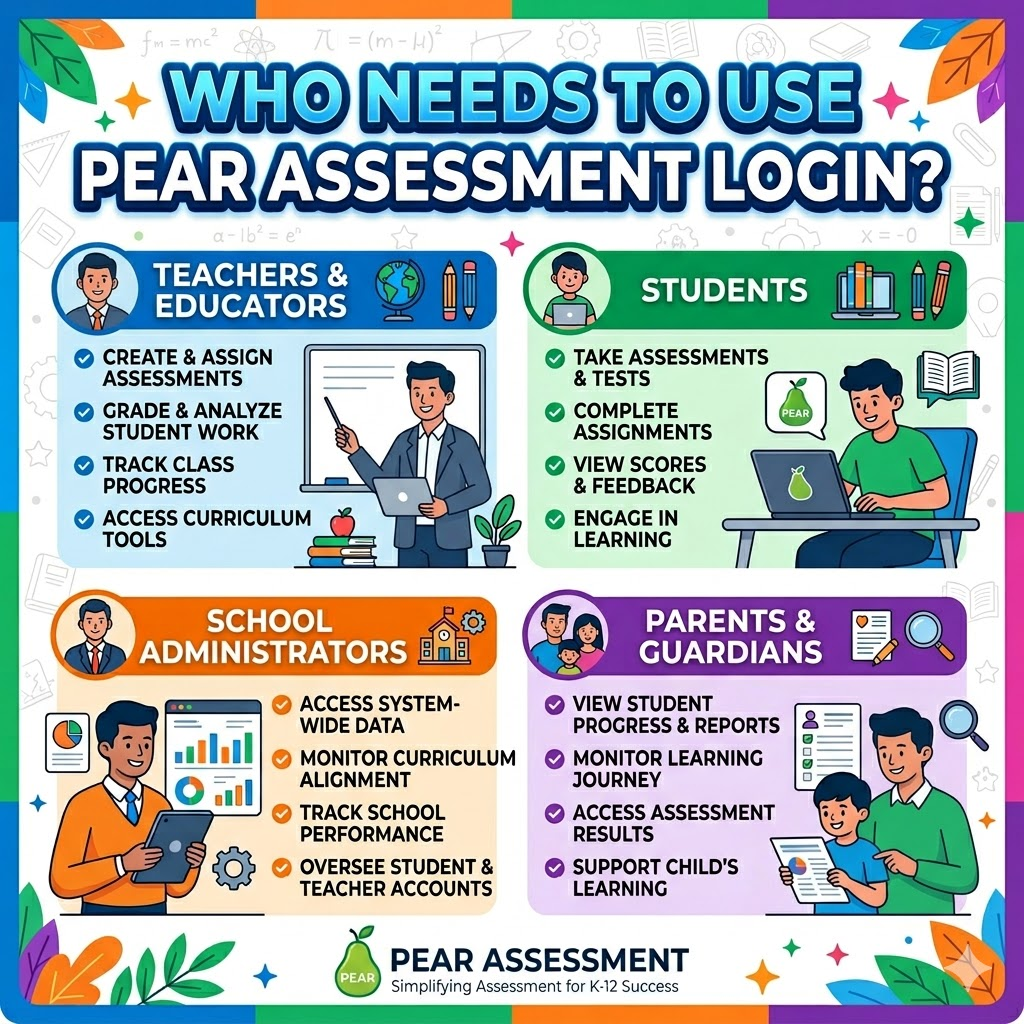
There are three primary user roles on the platform, and each has a distinct login pathway and post-login experience.
Students are the most frequent users. They log in to receive assigned quizzes, take tests in a secure browser environment, and view instant feedback once a session closes. Digital learning tools are gaining prominence in modern-day schools. Online assignments, quizzes, and practice tests are increasingly provided to students rather than on paper alone. A student login page is important because it puts students directly in touch with their study resources, evaluation exercises, and course progress at a single point.
Teachers use pear assessment login to create test items, build assignment pipelines, launch live assessments via the Live Class Board, and interpret standards-mastery data down to the individual question level. Thousands of K-12 teachers visit Pear Assessment daily, but many experience friction due to the fact that the platform has grown tremendously, particularly since Pear Assessment (previously Edulastic) became a part of Pear Deck Learning.
School and District Administrators access a higher-level view that spans multiple classrooms and campuses. Administrators have advanced access rights. They can manage multiple teacher accounts, monitor test completion rates, and view school-level data analytics. This feature helps institutions track learning performance effectively.
Understanding which role applies to you determines not only how you log in but also what you see when the dashboard opens — so clarifying this before your first session prevents a lot of confusion.
How to Complete Pear Assessment Login: Step-by-Step for Every User Type
Logging In as a Teacher
Teachers have four distinct methods available. Which one your school uses depends on decisions made at the IT or district administration level.
Method 1: Direct Email and Password
This is the universal fallback and works for any teacher regardless of what tools their district has deployed.
- Open a modern browser — Chrome is strongly recommended — and navigate to the official login page at assessment.peardeck.com/login.
- Enter the school or work email address tied to your Pear Assessment account. This should be your district-issued email (for example, yourname@districtname.edu), not a personal Gmail or Outlook address.
- Type your password and click Sign In.
- If you have forgotten your password, click “Forgot Password?” and a reset link will arrive in your inbox within a few minutes.
- Upon successful authentication, the Teacher Dashboard loads. New in the 2025 update is a toggle that lets you switch between the redesigned interface and the legacy view, giving experienced users time to adapt without disrupting their workflow.
Bookmark the URL assessment.peardeck.com/login in your browser favorites — it is the quickest way in, no matter how you log in.
Method 2: Sign In with Google
For schools operating on Google Workspace for Education, this is often the fastest and most seamless option. On the login page, click “Continue with Google,” select your school Google account from the pop-up, and grant any permissions requested. The system authenticates via Google’s OAuth flow, meaning no separate Pear Assessment password is required. Teachers are deposited directly into their dashboard in seconds.
Method 3: Sign In with Microsoft
Districts running Microsoft 365 can authenticate through Azure Active Directory. Clicking “Continue with Microsoft” launches the familiar Microsoft sign-in flow. This is typical of districts that support Microsoft Teams and Pear Assessment together. Once credentials are verified by Microsoft, the session opens inside the platform without the need to manage a separate password.
Method 4: Clever SSO (District-Managed)
Pear Assessment (formerly Edulastic) offers SSO through Clever Instant Login and rosters and provisions accounts through Clever Secure Sync. For teachers in Clever-integrated districts, the process is different: rather than navigating to the Pear Assessment login page directly, the teacher goes to the district’s Clever portal, finds the Pear Assessment tile in their app list, and clicks it. The session opens automatically with class rosters already synchronized. No separate credentials are needed, and no redirect to pear assessment login is required.
Logging In as a Student
Student login follows a slightly different path depending on how the school has configured account provisioning.
Option A: School-Provided Credentials
Most schools pre-create student accounts and distribute usernames and passwords through a school IT system or through the classroom teacher. The student visits the platform’s student-facing login page, enters the credentials provided by their school, and lands on their personal student dashboard where all assigned tests, quizzes, and past results are visible.
Option B: Google or Clever Single Sign-On
Pear Assessment supports easy sign-on through Google, MS365, or Clever, and allows syncing of class rosters and sharing of assignments in Google Classroom or an LMS, with grades pushed back to the gradebook. Students in Google Workspace environments may simply click “Sign in with Google” and select their school account. Clever-integrated schools route students through the Clever student portal, where a single click on the Pear Assessment tile opens the test environment with no manual credential entry.

Option C: Class Code Entry
For certain session types, especially shorter formative assessments, the teacher may provide students with a class code or session code. The student enters this code on the join page rather than going through a full pear assessment login flow. This is particularly useful for one-off assessments with younger students who may not yet manage their own account credentials independently.
Students access Pear Assessment by visiting the official website or app and entering their class code or credentials. After login, they can view available quizzes, start their tests, and see results instantly once submitted.
Logging In as an Administrator
District and school administrators typically access pear assessment login through the same portal as teachers but with elevated permission credentials. Once inside, the administrative dashboard presents a broader data landscape than the standard teacher view — school-wide assessment completion rates, class-level benchmarks, and cross-campus performance comparisons are all accessible from the admin panel. Administrators can also create and manage shared item banks, configure district-level SSO settings, and push standardized assessments to all teachers in a single action.
For first-time administrative setup, IT coordinators should work with Pear Deck Learning’s onboarding team to configure SSO federation, roster import via OneRoster or Clever Secure Sync, and data privacy agreements before any student-facing pear assessment login attempts are made.
Troubleshooting Pear Assessment Login Problems
Even on a well-configured system, login problems occur. Here is a comprehensive reference to the most common issues and the fastest resolutions.
Wrong Email Address
The single most frequent cause of failed teacher logins is using a personal email instead of a school-issued address. If your district provisioned your account with yourname@school.edu, entering yourname@gmail.com will return an “account not found” error even if the password is correct. Always confirm which email address is on record with your district’s IT department before troubleshooting further.
Password Rejected
Passwords expire, get reset by IT administrators, or are simply misremembered. The “Forgot Password?” link on the login page initiates a reset email. If the reset email never arrives, check your spam folder, and if it is still missing, confirm with IT that your account email address has not been changed.
Browser Cache and Cookie Conflicts
Stored browser data sometimes causes the login page to behave unexpectedly — it may load partially, loop back to the sign-in screen after authentication, or display a blank white page. Clearing the browser cache and cookies, then reloading the page in a fresh tab, resolves the majority of these cases. Alternatively, opening the login page in an incognito or private browsing window bypasses cached data entirely.
SSO Redirect Errors
When SSO redirects to an error page, the most likely cause is a misconfigured district SSO, and the recommended fix is to try an incognito window and contact the IT admin. District-managed SSO configurations occasionally drift out of sync, particularly after a school year transition, a domain change, or a Google Workspace policy update. If a teacher sees an error page after clicking “Continue with Google” or “Continue with Microsoft,” the problem almost certainly lives at the district IT level rather than inside Pear Assessment itself.
Kiosk Mode Errors for Students
During high-stakes assessments, the platform enforces kiosk mode — a browser lockdown that prevents students from navigating away from the test. If a student encounters an error entering kiosk mode, it is usually because the browser extension required for lockdown is not installed, the device’s operating system is outdated, or the student’s school-issued password needs to be updated through the district’s own identity management system.
Account Exists but Dashboard Is Empty
Teachers who successfully complete pear assessment login but find an empty dashboard may have been provisioned with a brand-new account that has not yet been synced with roster data. This is common at the start of a school year when Clever or OneRoster sync has not yet completed. Contacting the district’s instructional technology coordinator to trigger a manual roster sync typically resolves this within hours.
Summary Troubleshooting Table
| Symptom | Most Likely Cause | Recommended Fix |
|---|---|---|
| “Account not found” error | Personal email used instead of school email | Switch to district-issued email address |
| Password rejected | Expired or incorrect password | Use “Forgot Password?” to reset |
| Blank screen or spinning loader | Browser cache conflict | Clear cache; try incognito mode |
| SSO redirects to error page | District SSO misconfiguration | Contact school IT administrator |
| Kiosk mode refuses to launch | Missing browser extension or outdated OS | Install required extension; update browser |
| Dashboard loads but no classes visible | Roster sync not yet completed | Ask IT to trigger Clever or OneRoster sync |
| Student locked out of account | Credentials not distributed by teacher | Teacher must share login credentials or reset password |
Navigating the Dashboard After Pear Assessment Login
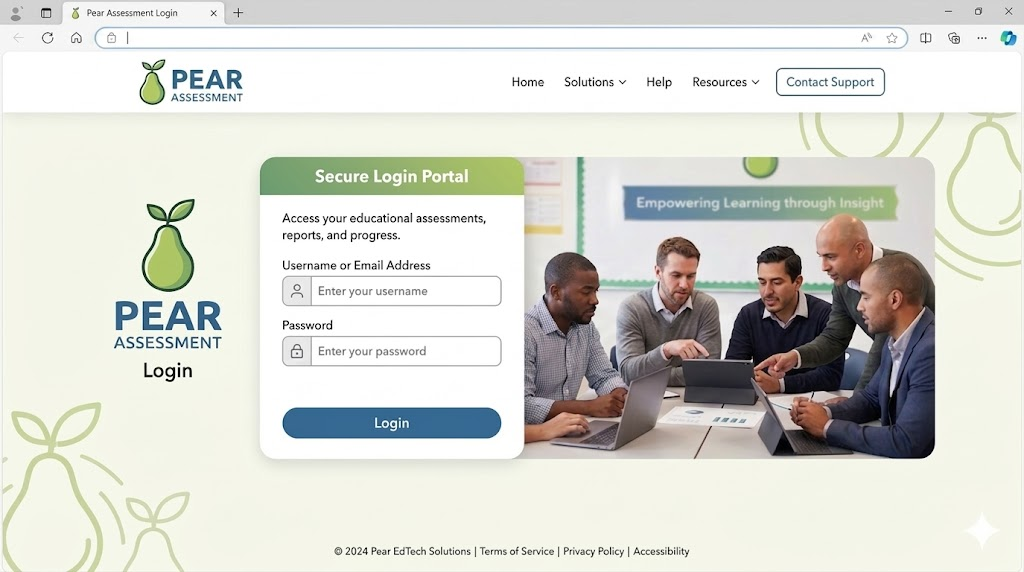
Successfully completing pear assessment login drops users into a role-specific dashboard. Understanding what each section does transforms the platform from an unfamiliar interface into a genuinely powerful instructional tool.
The Teacher Dashboard
Tests Library
The left-hand navigation panel surfaces the Tests section, which is the heart of content creation. Teachers can browse thousands of pre-built, standards-aligned assessments covering every core subject and grade band, or build entirely new tests from scratch. New in 2025 is AI-powered question generation (Premium) and the ability to import questions from Google Forms, DOCX, PDF, JPG, or PNG files — meaning years of paper assessments can be digitized automatically without re-entry.
Assignments and the Live Class Board
Once a test is assigned, the Live Class Board activates a real-time view of student progress. Teachers can see exactly who has started, who has paused, who has submitted, and — in kiosk mode — who has attempted to navigate away from the test window. This visibility eliminates the guesswork of paper-based administration and allows targeted in-class support before a student finishes.
Reports and Data Studio
In Reports, teachers can drill into standards-mastery data, question-level response frequency, and individual performance over time. Districts using Data Studio can map attendance, MTSS risk levels, and external academic data alongside assessment outcomes. This depth of analysis turns raw test scores into actionable instructional intelligence — identifying not just which students struggled, but on which specific standards and question types, enabling targeted reteaching rather than blunt review sessions.
Easy Assign and Pro Mode
Easy Assign simplifies settings to the most popular options to enable faster deployment. Advanced users can switch to Pro Mode for complete customization, including adaptive testing thresholds, dynamic passwords, and differentiated distribution. This two-tier approach makes the platform accessible to new teachers while retaining full sophistication for power users who want granular control over every assessment parameter.
The Student Dashboard
After pear assessment login, the student view is deliberately simpler. The screen surfaces a clean list of assigned assessments sorted by due date, alongside a history of completed work showing scores, teacher feedback, and standards-mastery indicators. For students, the dashboard shows assigned tests, completion status, grades, and feedback. This transparent layout encourages self-improvement and keeps learning goals organized.
Students can also review their own performance history over time — a feature particularly valuable for older students who want to identify recurring gaps before a high-stakes exam.
Integrations That Extend Pear Assessment Login Across Your Tools
One of the platform’s most significant strengths is how fluidly it integrates with the other software schools already use. These integrations make pear assessment login part of a seamless single sign-on ecosystem rather than yet another standalone portal demanding separate credentials.
Google Classroom
Pear Assessment integrates well with Google Classroom, Canvas, and other Learning Management Systems (LMS), making it easy to share assignments, sync class rosters, and update gradebooks. When a teacher assigns a test inside Pear Assessment, it can appear automatically in the student’s Google Classroom stream. Grades push back to the Classroom gradebook without manual export, eliminating double-entry.
Clever
Roster sync is automatic with Clever. When students enter or leave a class in the SIS, those changes propagate to Pear Assessment without any intervention by a teacher. For large districts managing hundreds of class sections, this automated synchronization is transformative — it removes a significant administrative burden from both teachers and IT staff.
Microsoft Teams and Azure AD
Microsoft 365 schools can authenticate through Azure AD and integrate assessment assignments directly into the Teams environment. Students in Teams-first districts complete assessments without ever needing to navigate to a separate pear assessment login page, as the platform surfaces through their existing Microsoft workflow.
OneRoster
OneRoster Auto Assign automatically matches new assignments to newly created classes according to specified criteria — a significant time-saving tool for administrators. For districts managing complex assignment schedules across many schools, this feature alone can justify the integration effort.
Canvas and Schoology
Beyond Google and Microsoft, the platform connects with Canvas and Schoology for schools using those LMS environments. Assignment creation, grade passback, and roster synchronization work similarly across all supported LMS integrations.
Security Features Built Into Pear Assessment Login and Testing
Security at the login layer and within active testing sessions is a priority, particularly for districts using the platform for high-stakes benchmark exams or state-test practice.
Dynamic Passwords
Rather than using static session codes that could be shared or leaked, the platform can generate dynamic passwords that expire after a short window, ensuring that only students who are physically present in the testing session can access the exam.
Browser Lockdown / Kiosk Mode
Additional layers of security include browser lockdowns and dynamic passwords, plus customizable settings, to ensure secure testing. Kiosk mode prevents students from opening other browser tabs, switching applications, or accessing external resources during an assessment. Teachers can enable this on a per-assignment basis without needing specialized hardware.
Account-Level Access Controls
Administrator-level users can configure which features are accessible to teacher and student roles, set password complexity requirements, and review account activity logs. For districts with strict data governance policies, these controls provide auditability alongside usability.
Data Privacy and Compliance
Pear Assessment operates under Pear Deck Learning’s privacy framework, which aligns with FERPA, COPPA, and state-level student data protection statutes. Schools sign a Data Processing Agreement (DPA) that governs how student data is collected, stored, and used, providing the legal clarity that district compliance officers require before deploying any EdTech platform at scale.
Free vs. Premium: What Each Plan Includes
Understanding the plan structure helps schools make informed decisions about which tier of pear assessment login access they need.
| Feature | Free Plan | Premium / Enterprise |
|---|---|---|
| Create and assign assessments | ✅ | ✅ |
| Standards-aligned item bank | Limited | Full (500,000+ items) |
| Automatic grading | ✅ | ✅ |
| Live Class Board | ✅ | ✅ |
| AI question generation | ❌ | ✅ |
| Adaptive testing | ❌ | ✅ |
| Data Studio analytics | ❌ | ✅ |
| DOCX / PDF question import | ❌ | ✅ |
| Dynamic passwords (kiosk) | Limited | Full customization |
| Clever / OneRoster roster sync | ❌ | ✅ |
| Priority support | ❌ | ✅ |
| Districtwide benchmark tools | ❌ | ✅ |
The free plan includes basic test creation, grading, and feedback features suitable for small classes. For schools, premium subscriptions provide advanced analytics, priority support, integration options, and unlimited test creation. Individual teachers exploring the platform before recommending it to their administration can accomplish quite a lot with the free tier, but any serious district-level deployment will require a Premium or Enterprise agreement.
Best Practices for Students Using Pear Assessment Login
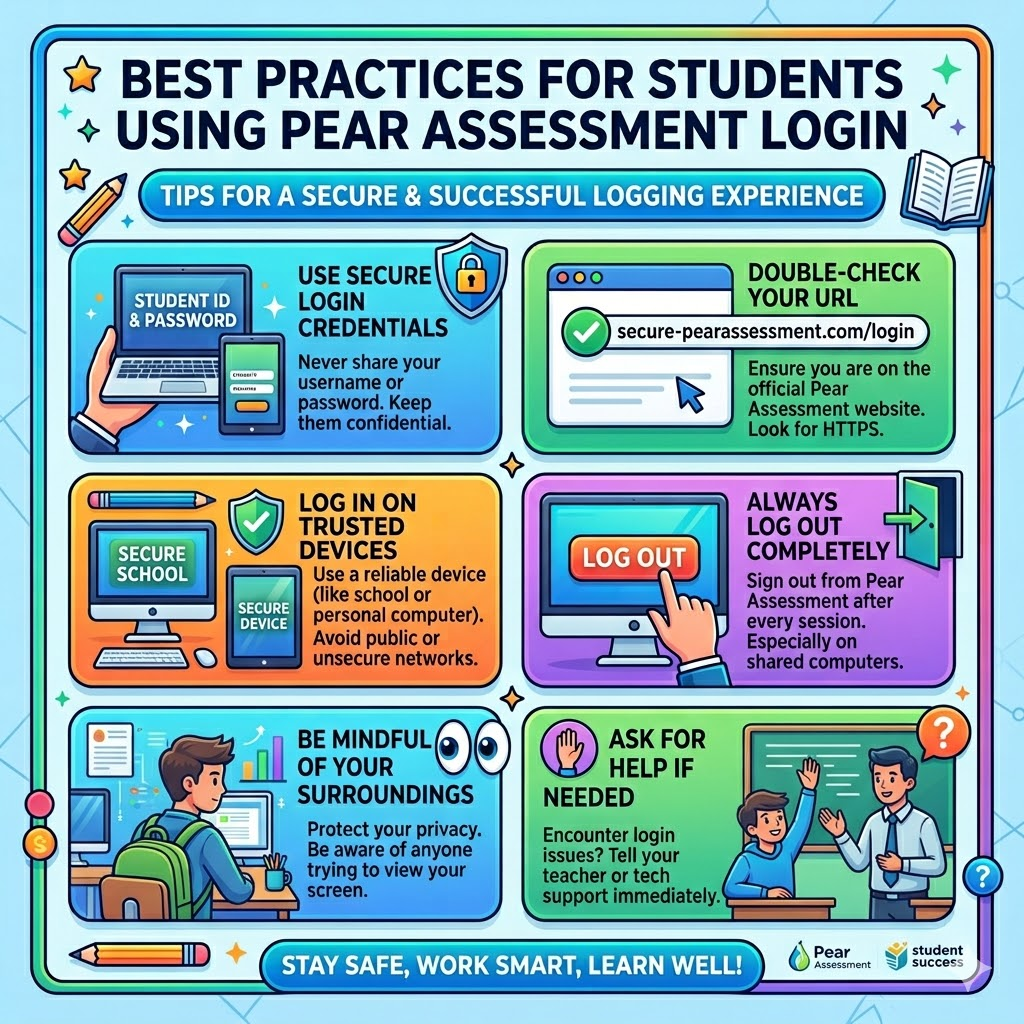
Getting the technical login right is just the first step. Students who build good habits around the platform learn more effectively and experience fewer disruptions during testing.
Keep login credentials confidential. Sharing usernames and passwords creates both security risks and academic integrity issues. Students should treat their login details with the same care they would a locker combination.
Use a reliable internet connection. Unstable Wi-Fi mid-assessment can cause answers to fail to save. Where possible, students should connect to the school’s main network rather than a personal hotspot. If an interruption does occur, the platform generally preserves progress up to the last autosave point, but reconnecting quickly minimizes any data loss.
Read instructions before starting. Some assessments have specific timing constraints, browser requirements, or submission rules. Reading the on-screen instructions before clicking “Start” avoids preventable errors.
Submit before the timer expires. Many assessments run on countdown timers. Students should aim to review their answers before the last minute rather than rushing through the final questions under time pressure.
Ask for help early. If a student cannot join a course or if an access code isn’t working, it is worth double-checking with the teacher. They are the best resource for specific class codes or enrollment details. Raising a hand early — rather than spending the full testing period trying to troubleshoot alone — protects both the student’s testing experience and their grade.
Best Practices for Teachers Using Pear Assessment Login
Bookmark the login URL. Navigating to the portal every time by searching a browser costs minutes that accumulate over a school year. Save the direct login page as a pinned browser tab or a home screen shortcut.
Verify your login method before the first day of testing. Whether your district uses Google SSO, Clever, Microsoft, or direct email authentication, confirm your credentials work before you need to administer a high-stakes assessment. Discovering a login problem five minutes before a benchmark exam is preventable.
Sync your roster early in the school year. If your district uses Clever or OneRoster, confirm that your current-year class rosters are reflected in Pear Assessment before assigning work to students. An empty class in the platform means students cannot access their pear assessment login dashboard and see the assigned work.
Use Easy Assign for routine checks. For daily exit tickets and weekly formatives, the Easy Assign mode reduces the number of clicks required to get an assessment in front of students. Save Pro Mode configuration — dynamic passwords, adaptive thresholds — for formal assessments where the additional control is genuinely needed.
Review Live Class Board data in real time. Rather than waiting for full submission to review results, watching the Live Class Board during an active assessment surfaces struggling students immediately, allowing in-the-moment intervention.
Export data to your gradebook promptly. Grade data lives in Pear Assessment’s reporting layer and in the integrated LMS, but maintaining timely gradebook updates keeps students and parents accurately informed of progress.
Pear Assessment on Mobile: App-Based Login
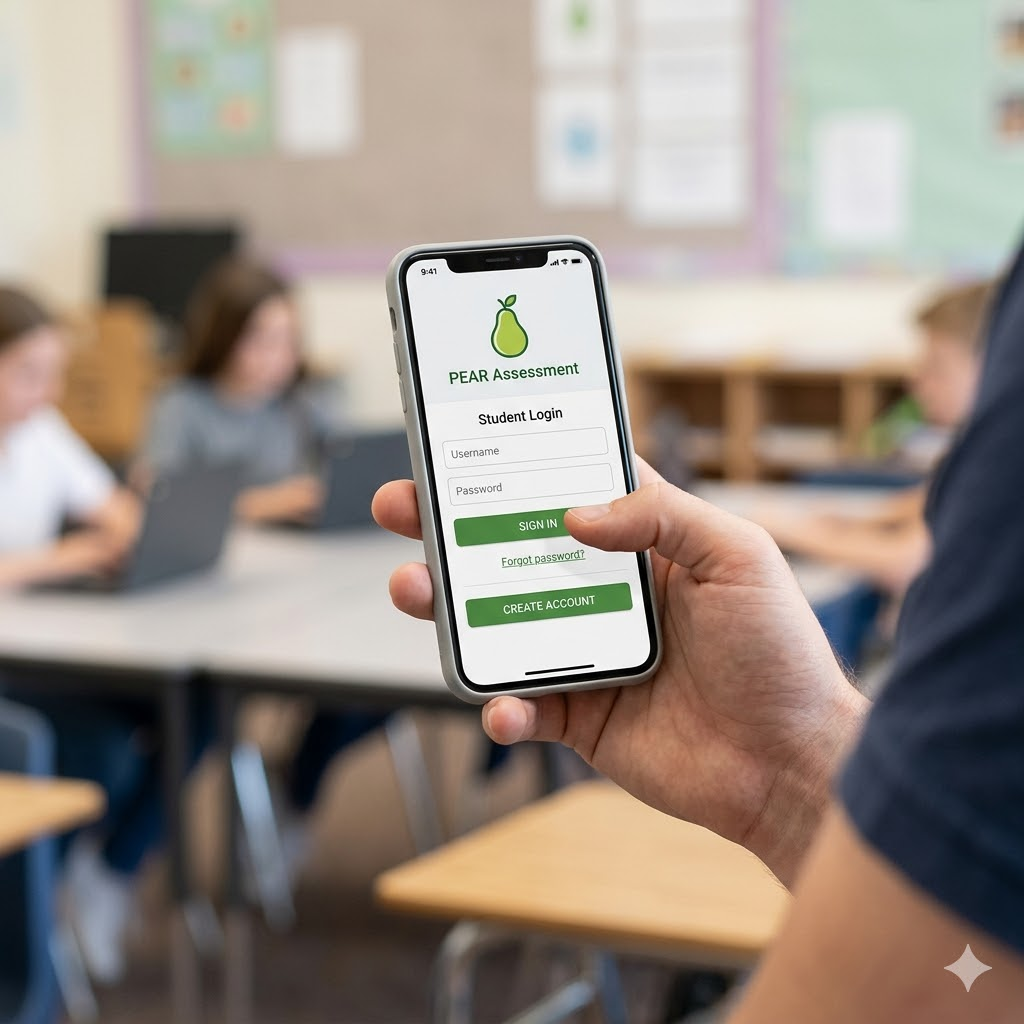
The Pear Assessment mobile app extends learning flexibility by allowing access anytime, anywhere. It is available on both Android and iOS platforms. The app-based pear assessment login experience mirrors the browser version closely — the same authentication options (email, Google, Microsoft, Clever) are available, and the student dashboard renders cleanly on smartphone and tablet screens.
For schools with one-to-one device programs, the mobile app is particularly useful in situations where students do not have access to a full desktop or laptop. Teachers conducting assessments in field settings or non-traditional learning environments can also distribute work through the app without requiring desktop infrastructure.
The mobile interface does not support every feature available in the full browser version — kiosk mode, for example, operates differently on mobile — but for standard classroom assessments, the experience is fully functional.
Pear Assessment Login for Administrators: A Deeper Look
District-level administrators encounter pear assessment login as a gateway to a fundamentally different view of the data landscape than what teachers see. The administrative dashboard aggregates performance data across every school and classroom in the district, enabling data-driven decisions at scale.
Key capabilities accessible after admin login include the ability to create district-wide shared item banks, ensuring every teacher pulls from the same vetted, standards-aligned pool of questions. Administrators can also configure district-level testing schedules, push assessment assignments to all relevant teachers simultaneously, and set role-based access permissions that govern what teachers and students can and cannot do within their own dashboards.
Collaboration is encouraged, as teachers can share and use assessments across schools and districts. This sharing infrastructure is enabled and governed at the administrative level — admins define which item banks and assessments are openly accessible versus restricted, maintaining quality control across the district’s assessment program.
For MTSS and multi-tiered support coordinators, the Data Studio available in the Premium/Enterprise tier after admin login brings external data — attendance records, benchmark trends, risk indicators — into the same analytical environment as assessment outcomes, enabling a 360-degree view of student need.
Frequently Asked Questions
What is the official Pear Assessment login page address?
The primary login portal for teachers and administrators is assessment.peardeck.com/login. Students may use the same portal with their school-issued credentials, access through Clever, or join via a class code provided by their teacher. Bookmark the direct address rather than searching for it each time.
Can students log in without a password?
Yes, in certain configurations. Students in Clever-integrated districts click a single tile in the Clever student portal and are authenticated automatically. Students joining a Pear Deck lesson session use a five-letter join code rather than any account credentials at all, though this applies to Pear Deck interactive lessons rather than formal Pear Assessment tests.
What should I do if my login email is not recognized?
Confirm that you are using your school or district-issued email address, not a personal account. If you are certain the email is correct and still receive an error, contact your district’s IT department to verify that your account exists in the system and that no spelling variation or alias is creating a mismatch.
How do I reset my Pear Assessment password?
Click the “Forgot Password?” link on the login page. A reset email arrives within a few minutes to the address on file. If the email does not arrive, check your spam folder, confirm the email address with IT, and if necessary request that your IT administrator manually trigger a password reset from the admin console.
Is Pear Assessment the same as Edulastic?
Yes. Pear Assessment was formerly called Edulastic, which was purchased by Pear Deck. The platform’s core feature set is the same, but it now operates under the Pear Deck Learning brand umbrella. The login portal has migrated accordingly, so users who were accustomed to the Edulastic login address should update their bookmarks to assessment.peardeck.com/login.
Does Pear Assessment support Single Sign-On?
For schools that use Google Workspace or Microsoft accounts, Pear Assessment supports single sign-on (SSO), allowing easy and secure login without multiple passwords. Clever SSO is also supported and is particularly common in districts that use Clever as their central app provisioning platform.
What browsers work best with Pear Assessment?
Google Chrome is the recommended and most thoroughly supported browser. Mozilla Firefox and Microsoft Edge (Chromium-based) also work reliably. Safari on macOS and iOS is generally compatible, though some technology-enhanced question types render most predictably in Chrome. Older or non-updated browsers can cause unexpected behaviors, so keeping the browser current is a simple preventive measure.
Can teachers see a student’s screen during an assessment?
The Live Class Board shows which questions students are on, whether they have submitted, and — in kiosk mode — whether they have attempted to navigate away from the assessment window. Teachers do not see a direct screen mirror, but the platform flags students who exit the test window, providing a meaningful academic integrity signal during high-stakes testing sessions.
What happens if a student’s internet drops during a test?
The platform autosaves student responses continuously. If a connection drops mid-assessment, answers entered before the interruption are preserved. When the student reconnects and completes pear assessment login again, they can resume from where they left off — provided the teacher has not closed the testing window. Teachers should set a generous session window for assessments conducted in environments where connectivity may be unreliable.
Is there a cost for students to use Pear Assessment?
No. Student access to the platform is covered by the school or district account. Teachers can create technology-enhanced, standards-aligned assessments and get instant data to drive instruction, for free, meaning even on the free tier, students bear no cost whatsoever. Premium plans are purchased at the institutional level, not charged to individual students or families.
How do I contact Pear Assessment support?
The primary support portal is support.peardeck.com. From there, users can submit a help ticket, access the knowledge base, or initiate live chat during business hours. District-level Premium and Enterprise customers have access to dedicated support representatives with faster response time commitments.
Summary and Key Takeaways
Pear Assessment is one of the most capable digital assessment platforms serving K–12 education today, and everything on the platform flows through pear assessment login. Whether you are a student trying to complete a Friday quiz, a teacher racing to pull last week’s performance data before homeroom ends, or a district administrator preparing for a school board presentation on benchmark trends, mastering the login process is the foundational skill from which everything else follows.